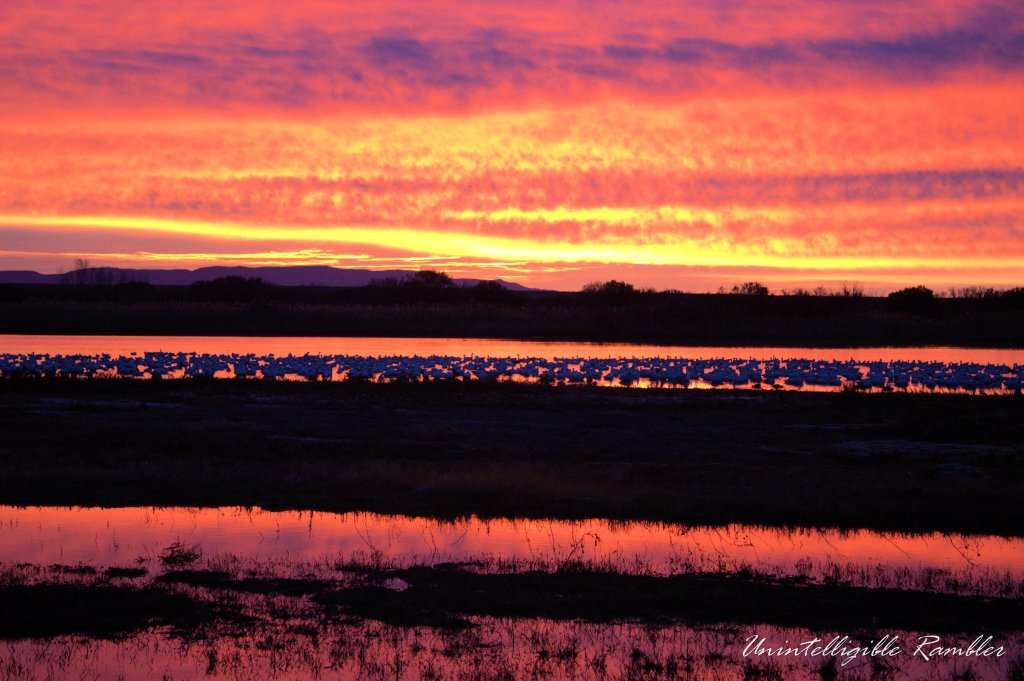
The first week of the Big Year started out slower than I would have liked, but I still ended up with 70 species listed and traveled over 1,400 miles visiting spectacular sites around the state. I missed a few target species, but found a few unexpected delights. Read on for a full accounting of my adventures over week 1.
New Year’s Day
The first day of the new year began with anticipation and excitement, ready to start with a bang. I had a trip planned to Clovis, Melrose, Fort Sumner, and Santa Rosa, sure to start the year with a plethora of birds for my list. I planned to gather a full list of ducks, geese, grebes, and mergansers from the small ponds scattered along the route. Sadly, weather and holiday closures hampered my plans.

I started the day at Ned Houk Park just north of Clovis. The park had plenty of Canada Geese and Cackling Geese, but few other waterfowl. I was able to check off several common species and get started with 15 sightings. While driving around the park, I was surprised to see bison grazing in a field to the south.
After visiting Ned Houk, my plan was to visit the Clovis Wastewater Treatment Plant. Several species of waterfowl are known to frequent the facility, and occasionally, rarities such as swans are spotted there. I made the drive to the plant only to find the gates closed and no way to access the site due to the New Year’s holiday. My dreams of seeing waterfowl swimming in foul ponds would have to wait for another day.
Oasis and the Melrose Woods were equally disappointing. The pond at Oasis was filled with anglers and not a bird in sight. I did find a few sparrows and a Ladder-backed Woodpecker while walking the trails, but nothing much else. By the time I made it to Melrose Woods, the winds were howling. I didn’t spend much time under the canopy of decaying cottonwoods and poplars for fear of deadfall. The only birds moving were a Ladder-backed Woodpecker and some Mourning Dove.

Bosque Redondo Park in Fort Sumner provided a couple of Pied-billed Grebes and a shy Great Blue Heron hiding in the reeds. When I arrived, the winds were still strong, and there was a slight drizzle. Despite the weather, Bella and I took a walk around the pond only to find all the birds in hiding. There was one raptor in the distance that appeared to be a Red-tailed Hawk, but it was too far off to make a positive identification.
By far, the highlight of the first day was Sumner Lake State Park. While the gusty winds made it unbearable to bird on the main lake, the area below the dam was quite productive. As I was driving below the dam, a Brown Thrasher flew in front of the truck. I got out and sauntered around a bit, and I was able to find several American Robins, Dark-eyed Juncos, and even a couple of Ruby-crowned Kinglets and a Brown Creeper.
I ended the day trying to make a last-ditch effort to see waterfowl in Santa Rosa. Unfortunately, I underestimated how long it would take to see everything else and made it there with only a few rays of light left in the day. Day 1 total species seen – 26.
Warblers, Gulls, and the Bosque del Apache
On Saturday, January 3, 2026, my wife and I rose long before the dawn to hit the road on a long-planned trip to Bosque del Apache National Wildlife Refuge. I’d been wanting to take her there to see the cranes and geese, and only found out about the Big Year contest after planning the trip. At least that’s my story!
Our plan was to head directly to the refuge and spend the entire day birding there; however, a rare sighting of a Pine Warbler in Santa Fe enticed me to take a detour. We arrived at the State Capitol just before 8:00 a.m. and found other birders already there. We asked, “Is it here?” “Haven’t seen it yet”, they responded. It’s still amazing to me that while out birding, you can show up to a location, see another person with binoculars and a camera, and ask, “Is it here?” and they instantly know what you mean.

We spent about an hour looking for the Pine Warbler without success. Aaron thought she saw it a couple of times, but wasn’t really sure. Another birder found the bird near the Capitol Building and tried to help us find it without luck. I’ve always found that most birders are super friendly and excited to help others find birds, especially rare ones.
After getting skunked by the Pine Warbler, we stopped off at the Bosque in Albuquerque to seek a Lesser Black-backed Gull and Short-billed Gull that were spotted earlier in the week. Again, our target birds eluded us, but we were consoled with a sighting of a Great Egret.
While searching the wilds of Albuquerque, or anywhere for that matter, I would strongly advise against placing all your faith in Google Maps. Throughout the week, the application took me to locked gates, random neighborhoods, and even directed me down an unmaintained mountain road sure to be snow-covered and treacherous this time of year. Of course, I didn’t take its advice to travel down that road.
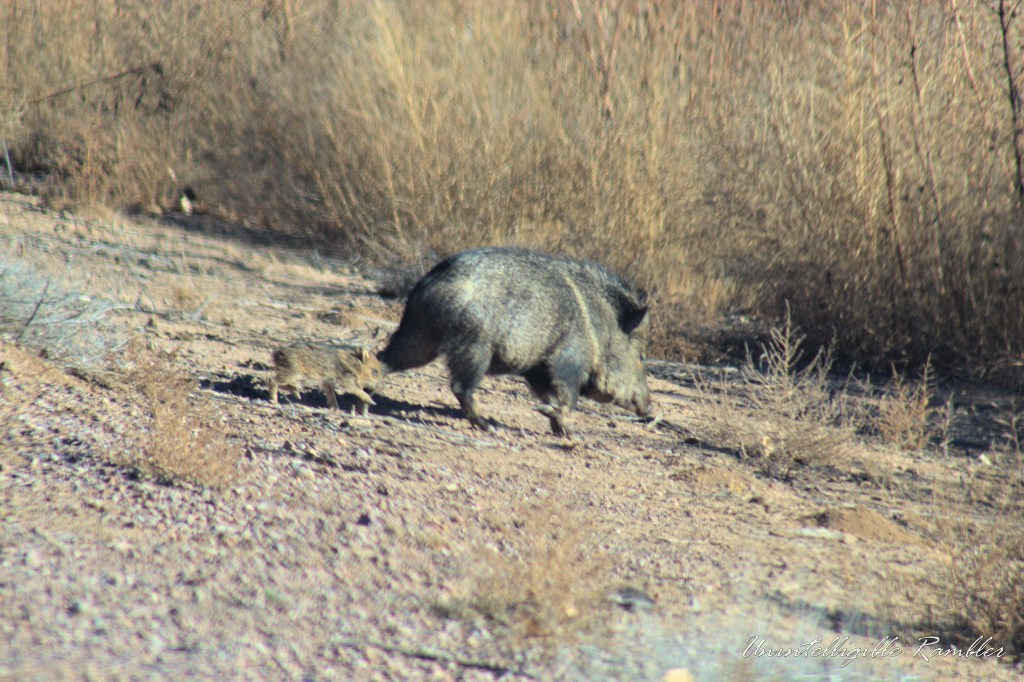
While driving to the Bosque del Apache, Aaron caught a nap, and I listened to The Big Year by Mark Obmascik. We arrived at the fabled birding paradise around 2:00 p.m. We had just enough time to drive the main loop before heading back to Socorro for mass and dinner. While making the loop, we were treated to views of not only avian life but also several 4-legged critters. The highlight of the day was a baby javelina scurrying across the road trying to keep up with its mother.
Day 2 at the Bosque began with me standing by a pond before dawn, freezing, while Aaron sat in the truck to stay warm. We were waiting for the morning flight of snow geese. When we arrived, I was afraid we were in the wrong spot as there were no birds to be seen on the water, but after a while, several other birders showed up, and the geese began flying in and landing on the pond. It seems as though the pond was the meeting spot for the geese, where they all gathered prior to heading out to the fields for the day.
While I stood there in the cold, marvelling at the flocks of birds filling the pond, I realized I had drunk too much coffee and needed to get rid of some. However, there was no way I was giving up my spot, as the shoreline was packed with birders at this point, and I had a front-row seat.
Slightly before sunrise, the geese decided it was time and almost in unison took off from the pond, filling the sky with a cackling mass of white. They flew around a couple of times and headed out to their feeding grounds.
After watching the morning flight, we decided to drive the loop and hike some trails. My goal was to find a Virginia Rail on this trip, and I was certain the Boardwalk Trail or the Rio Viejo Trail was the perfect spot to find one. Aaron toughed out the cold and trudged along with me on the trails, only to be disappointed as the walking paths were devoid of life. Our only assumption was that the trail birds slept in on Sundays or perhaps were at church.
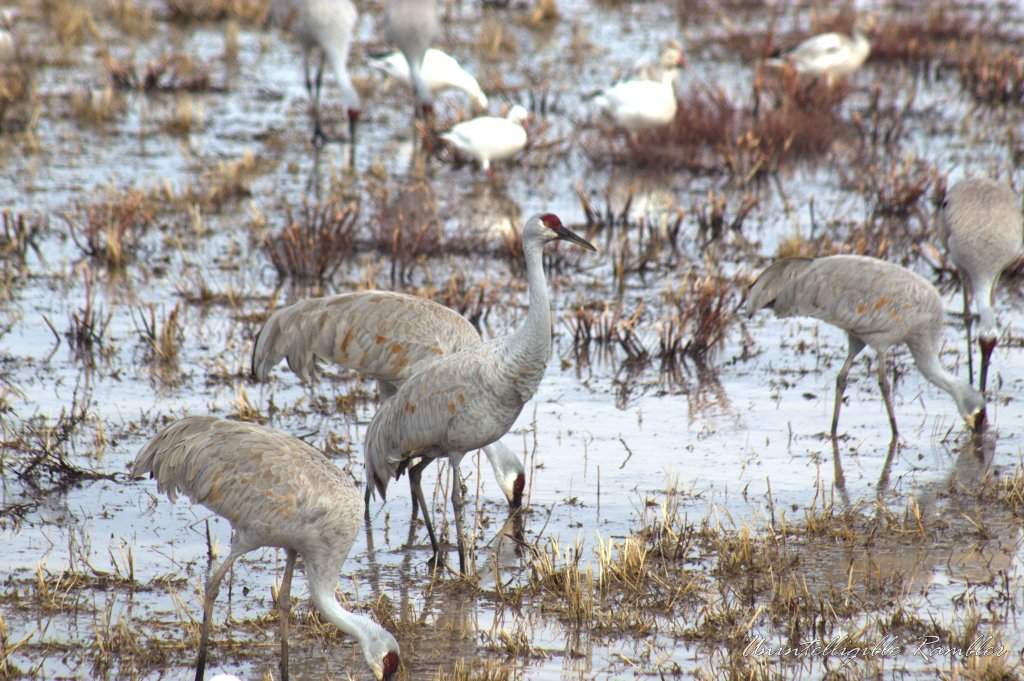
We spent the rest of the day driving the loop, stopping to look at ponds and watch cranes and ducks feed. It seemed as though there were fewer cranes than on previous visits, and a gentleman at the goose flight confirmed my suspicion. He indicated he was on the Friends Board, and the issue was with government cuts; the refuge was unable to plant as much forage for the cranes, causing them to seek alternate areas.
After seeing all we could at the refuge, we decided it was time to head home. We made a quick stop at Turtle Bay Pond in Socorro to try and find a Gray Catbird, but instead were mobbed by domestic ducks looking for a handout.
On top of the world
On January 7, 2026, I had to go to Albuquerque for a doctor’s appointment. I decided to make the best of it and see some birds while there. I started the morning making the winding drive up to Sandia Crest in search of Rosy-Finches.
I arrived at the top around 8:00 a.m., and there were only two other cars in the parking area. At first, I wasn’t sure I was in the right location. I wandered up to the overlook for awe-inspiring views of the surrounding desert and felt anxious. The view from the top is breathtaking, but I couldn’t help but feel uneasy. I don’t know if it was the altitude, a fear of heights, or just the lack of oxygen, but there’s definitely a different feeling when you’re standing atop the Crest looking down on Albuquerque.
After realizing I wouldn’t fall off the mountain, I located the feeders and two other birders waiting for the Rosy-Finches. They had come all the way from Pennsylvania and Ohio to do a birding trip in New Mexico. Many people don’t realize the tremendous diversity of birdlife we have, but we are one of the top states for birding in the nation.
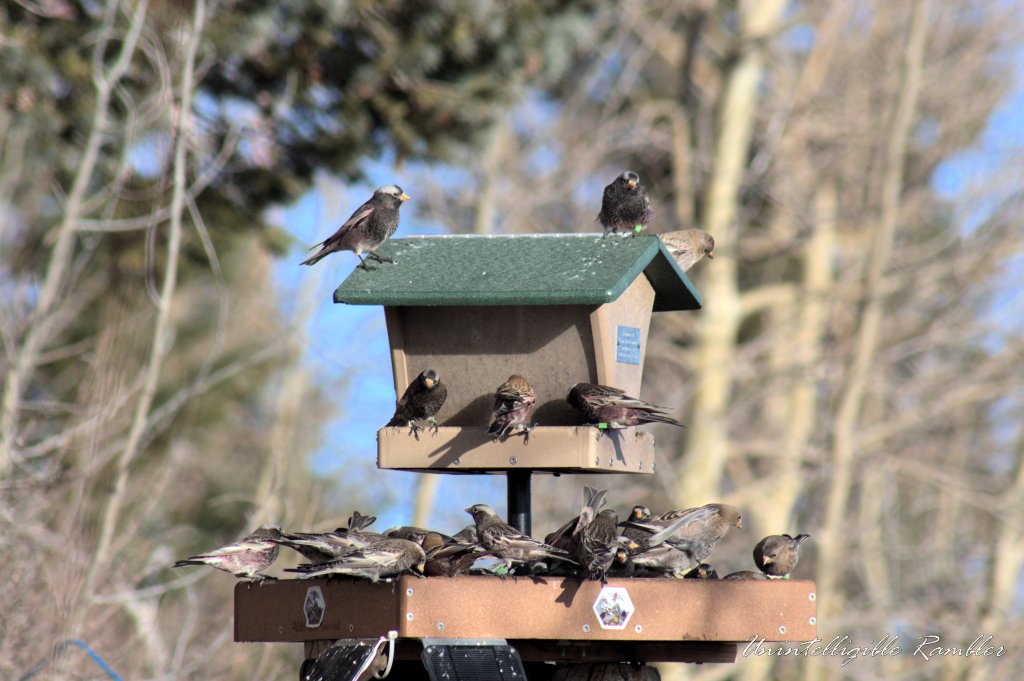
After waiting a few minutes, the Rosy-Finches appeared in a massive flock. They swarmed the feeder and perched in nearby trees. All three species were present, but the Black Rosy-Finches seemed to be the most numerous. Now, you’re supposed to count the number of birds you see and record them if you’re a serious birder, but I haven’t always followed that rule. Often, I get overcome with joy at the sight of a flock of birds and don’t get an accurate count. Who can think of math when marveling at the beauty of these magnificent creatures?
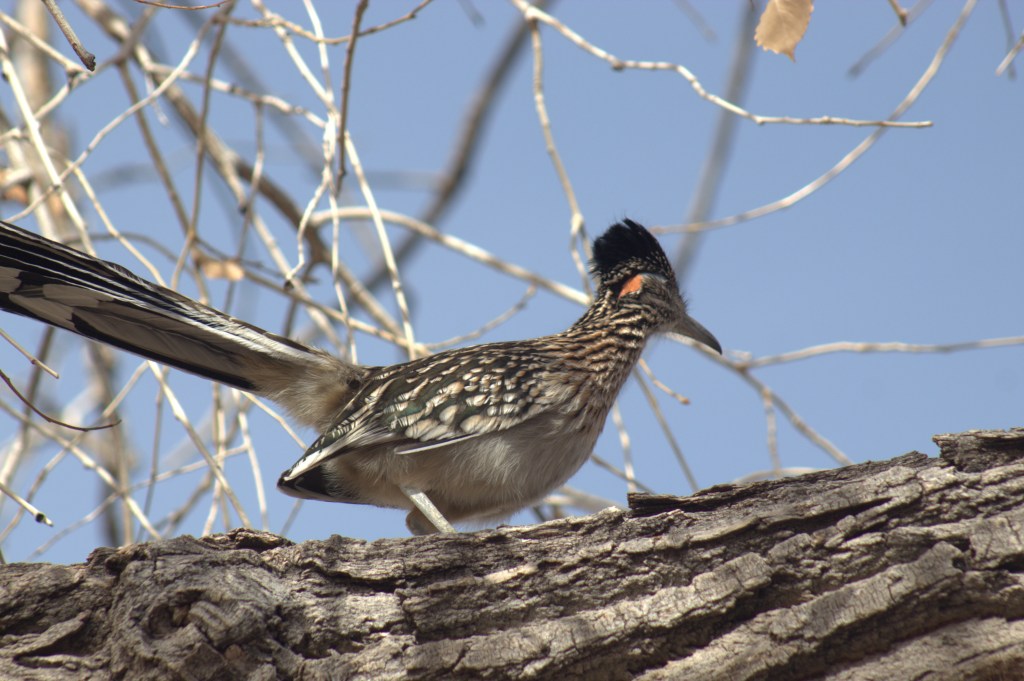
After the Rosy-Finches left, I ventured back down the mountain and headed to my appointment. Afterwards, I attempted once again to find the rare gulls that were spotted in the Albuquerque Bosque, but was again disappointed. I did get to see a cute Black Phoebe perched on a tree by the drain, but it wouldn’t sit still for a picture. The roadrunners at Willow Creek Open Space, however, were more than happy to pose.
On to next week…
Overall, I have to say it was a great first week of the Big Year. Even though I didn’t see everything I wanted, I was able to visit new locations and make memories with Aaron and Bella. My total count today is 70 species, well short of the leader. Although this Big Year for me isn’t about being the leader, I can’t help but check the Top 100 list regularly. I’ll be satisfied if I can remain in the top 100 throughout the year.

 Unintelligible Rambler
Leave a comment